GROMACS Wizard - PMF Analysis#
This section is part of the GROMACS Wizard tutorial.
Use this page after an umbrella-sampling workflow when you want to convert the windowed simulation data into a Potential of Mean Force (PMF) profile.
In GROMACS Wizard, PMF analysis is performed with the Weighted Histogram Analysis Method (WHAM).
What you will learn#
In this tutorial, you will learn how to compute the Potential of Mean Force using the Weighted Histogram Analysis Method with GROMACS Wizard.
Before you start#
- Finish an Umbrella Sampling workflow first.
- Make sure the input folder contains matching subprojects for the same system and reaction-coordinate setup.
Compute the PMF#
Switch to the WHAM Analysis tab in GROMACS Wizard.
- Choose the project path, or click auto-fill (
 ) if the previous project you ran was the Umbrella Sampling simulation.
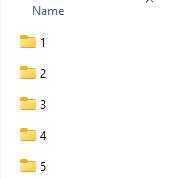
 - Confirm that the project folder contains numbered subfolders for the same system and the same reaction-coordinate definition.
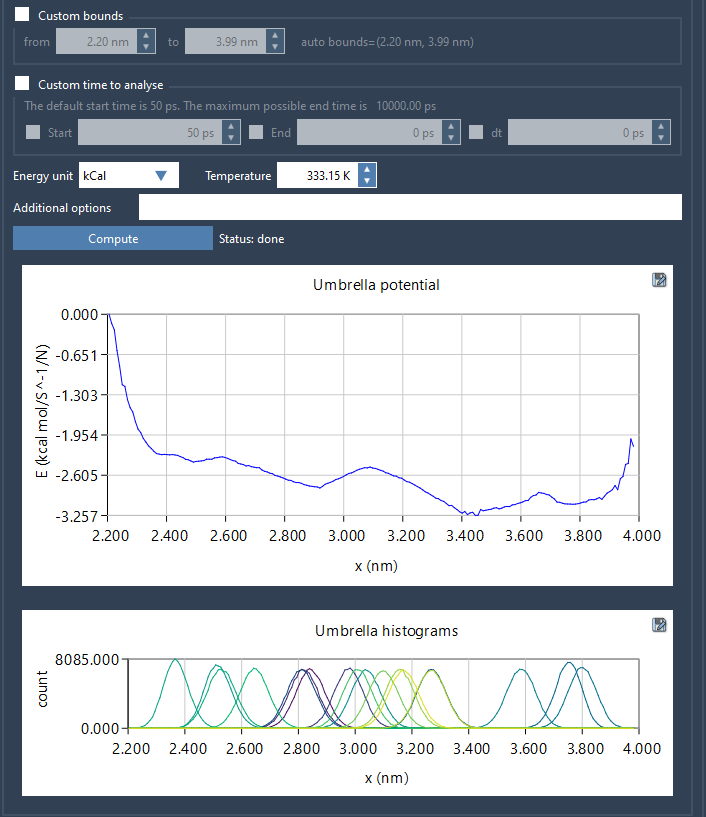
GROMACS Wizard loads the reaction-coordinate information, time range, and temperature from the project automatically.
- Choose the reaction coordinate from the list.
- Adjust optional settings such as custom bounds, custom time range, or energy units if needed.
- Click Compute.
GROMACS Wizard then generates two plots:
- the PMF profile
- the histogram showing how well the coordinate space is covered
For large trajectories, the computation may take several seconds or minutes.
Interpreting the result#
The histogram shows how well the reaction-coordinate space is covered and helps you spot regions where additional sampling may be needed.
Once the computation is finished, GROMACS Wizard saves the profiles, histograms, and plots in the wham_results subfolder of the project. If you switch between reaction coordinates later, the tool reuses the already computed data for the same parameters.
Related tutorials#
- Umbrella Sampling for generating the umbrella sampling data used by PMF analysis.
- COM Pulling for preparing pulling trajectories that can seed umbrella sampling windows.
Next step#
Inspect the PMF profile and histogram coverage. If sampling is insufficient in some regions, return to Umbrella Sampling and add or extend simulations for those windows.